| Short Name of Project |
IDENTIFYD |
| Full Name of Project |
IDENTIFying the risk of recurrent and chronic Youth Depression
(IDENTIFYD): A prospective longitudinal cohort study
|
|
Principal Investigator
|
Professor Lianne Schmaal |
| Project Sponsor |
Orygen |
| Site Name |
headspace National |
What am I being invited to do?
We, the Orygen Mood Research Team, invite your child to take part in a
project that is trying to identify the risk factors that contribute to
young people experiencing long term or repeated depression. Your child
has been invited to take part because your child is a young person
between 15 and 25 years old, who is a client of headspace with an
experience of depression, and you have indicated you may be interested
in participating in this study.
Around 3000 young people will take part in this project. They will be
clients of any headspace centre in Australia.
Please read this information and feel free to ask any questions. You
can take some time to make up your mind and decide if this project is
right for you. You can also talk to someone you trust, like a family
member, friend, or your local doctor.
What is the purpose of this project?
In this project, our aim is to create a tool to identify young people
who are at risk of experiencing long‑term or repeated depression. This
tool is called a ‘risk calculator’. The tool will consider a wide
range of aspects of a young person’s life, including clinical, medical
and pharmaceutical history (optional), cognitive, psychological, and
social factors that are linked to depression (see a visual
representation of this in figure 1 below).
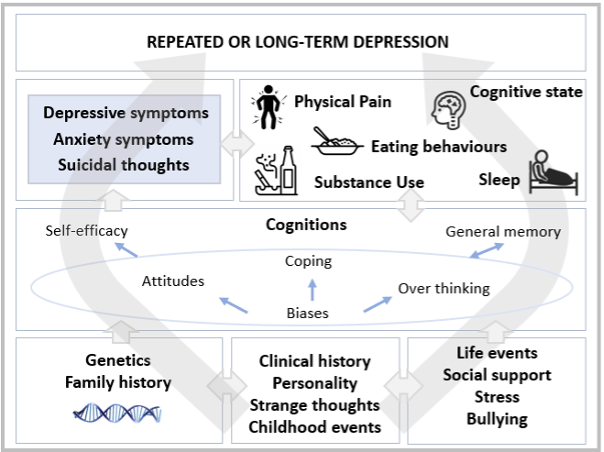
Figure 1: Factors in repeated or long-term depression
As well, the study is interested in identifying factors that impact
young people’s recovery from depression, and development of other
mental health concerns (such as anxiety).
Your child can participate in genetic testing by providing a saliva
sample. This will help us to identify genetic factors linked to
depression, offering insights into its causes, risk factors, and
potential personalised treatments.
Do I have to take part and can I change my mind?
Taking part is up to you and your child
You and your child get to decide whether your child will take part in
this project. You can say yes or no.
Your decision won’t affect your relationship with your headspace
clinician or the research team at Orygen, or headspace, or Orygen. If
you don’t take part, your engagement with headspace will continue as
normal.
You can change your mind at any time
If your child does take part, they can stop at any time. If your child
wants to stop, you or your child should tell someone in the project
team. Your child does not have to tell us the reason.
Once your child stops taking part, we will not collect any more
information about them. We will keep the information we have already
collected to make sure the results of the project can be measured
properly.
The project might stop for other reasons
We might need to stop the project while your child is taking part. If
this happens, we will explain the reasons to you and your child.
We may also ask your child to stop taking part in the project if it is
no longer in their best interest. If this happens, we will discuss
this with you and your child.
What does my child have to do if they take part?
If your child takes part in this project, they will be in it for 18
months from the time the your child complete the first assessment.
This table below outlines what your child needs to do in this project.
For more information, please ask a member of the project team.
Your child will be reimbursed for the participation. More detail about
reimbursement is found later in this document.
The main component of the study involves completion of online surveys across 18 months. These surveys contain a variety of questionnaires asking questions about your child’s life circumstances, lifestyle, sleep habits, mood symptoms, strange thoughts, suicidal thoughts and behaviours, eating disorders, personality, physical pain symptoms, memory and attention. If an individual under the age of 18 exhibits indications of active suicidality, their parents or legal guardians will be informed.
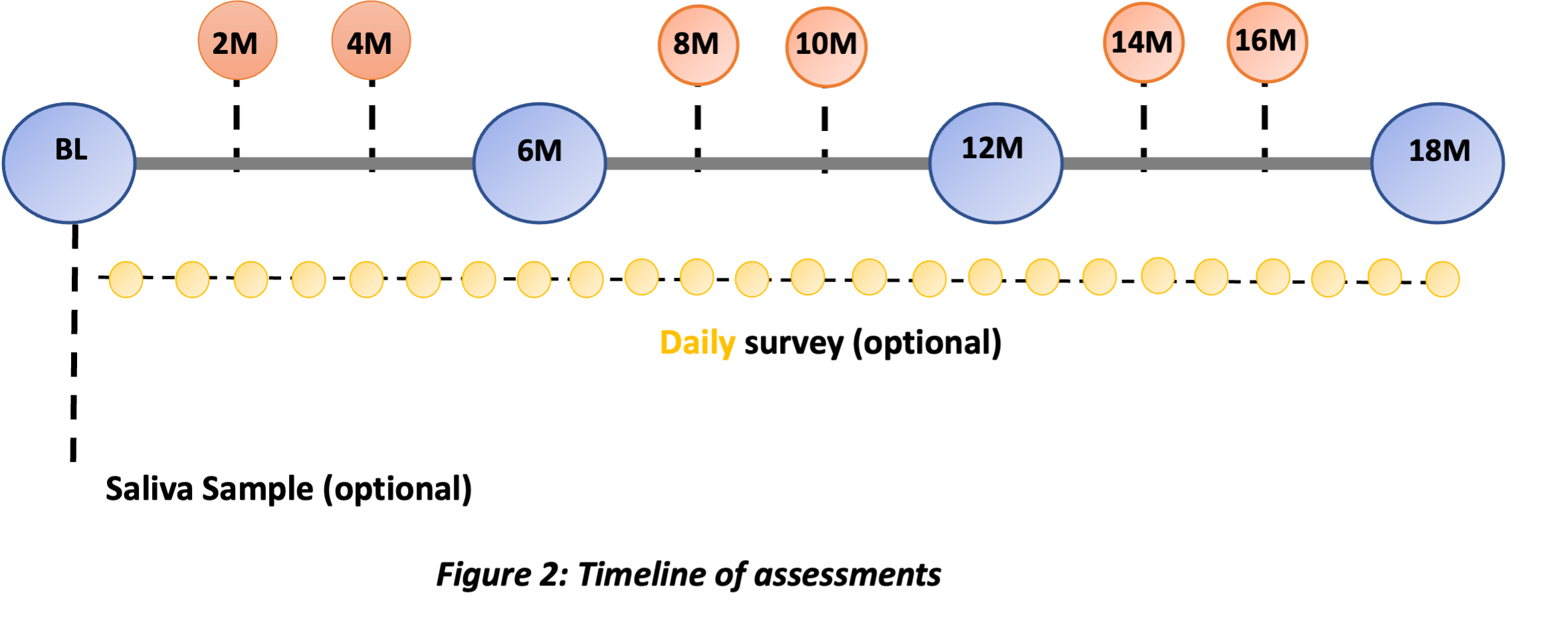
If you and your child consent to participate they will be asked to complete 10 online surveys over a period of 18 months (see visual representation of this in figure 2 below). Once your child is enrolled in the study, they will receive an online baseline survey, which will take approximately 2 hours to complete. Following, the baseline survey, your child will receive 15-minute surveys every 2 months through the study period of 18 months
The 6-, 12-, and 18-month surveys will have a few additional questions and are expected to take 30 minutes in total to complete. The online surveys can be completed either on a computer, tablet, or mobile phone.
Up to 690 participants will also be contacted to recruit a random sample of up to 276 participants to to complete a questionnaire about depression and anxiety over the phone or via videoconferencing with a research team member. It is expected this would take up to 60 minutes to complete. Contact will occur at baseline and at 6 month follow up, with a total of 138 participants required for each time point. If your child is randomly selected, you can decline to participate without it effecting their involvement in any other aspects of the study. There are also three additional optional components of the study, which are described below.
Optional component 1: Brief daily survey on your
smartphone.
Your child will have the option to participate in short (2-3 minute) daily surveys that will ask some questions about what they are doing, what they are thinking and how your child is feeling. To do this you will need to install an application called mPATH on their mobile phone. Surveys are sent once daily. Your child can also request that the frequency with which they receive the surveys is reduced for certain periods of time throughout the study, or to pause them completely for a period, if they would like a break from it. The application mPATH is owned by a Belgium Company called M-PATH Software and we license it from them. M-PATH Software will only receive deidentified data about your child. M-PATH Software may use that data to improve and further develop the software and the m-Path services and only can process the information as strictly as necessary for its purposes
Choosing not to participate in optional component 1 or withdrawing from optional component 1 does not stop your child from participating in the main study or optional component 2 or optional component 3.
Optional component 2: Genetic assessment via saliva
sample
Your child also has the option to participate in genetic testing by providing us with a saliva sample
What is genetic epidemiological research?
Genes are made of DNA – the chemical structure carrying your genetic information that determines many human characteristics such as the colour of your eyes or hair. Researchers study genes to understand why some people have a certain condition such as depression and why some people do not. Understanding a person’s genes may also explain why some people respond to a treatment while others don’t, or why some people experience side effects and others don’t.
If you and your child consent to this, you will be sent a saliva test kit with all required materials and instructions and a pre-paid return post envelope. Your child will be required to post the sample back to the study co investigators at the University of Queensland via the pre-paid return post envelope (at no cost to you). You or your child will be able to contact a member of the research team if you need any help or advice about completing the process. We will extract your child’s DNA from your sample to investigate genetic risk factors for depression and medication response. Due to the nature of the analysis, we will not be able to provide the results from these tests.
Choosing not to participate in optional component 2 or withdrawing from optional component 2 does not stop your child from participating in the main study or optional component 1.
Optional component 3: Access to Medicare and
Pharmaceutical Benefits Schedule information
Australian Institute of Health and Welfare National Health Database Hub, and State and Territory Based Ambulance Services.
To also help determine the cost to society of peoples experience of mental health concerns, as well as to explore other factors that may help understand outcomes related to depression the team will seek to access your child’s information that is available from the National Health Data Hub (NHDH) via the Australian Institute of Health and Welfare (AIHW), and your information that is available from the ambulance service in your state.
The NHDH is an enduring linked data system that provides information from a variety of databases across Australian states and territories. If, you provide consent to this, the research team would provide your child’s information to the AIHW NHDH team in a secure manner, and they then provide the research team with your relevant data in a deidentified manner via a secure online portal.
For State Based Ambulance Services data, researchers will provide your child’s information to the relevant members of the ambulance service, and they will provide your data back to the research team in a secure and identifiable manner. The research team will then take responsibility for ensuring only authorised study members have access to the information in an identifiable form, and will only present your child’s data publicly in a de-identified manner.
Choosing not to participate in optional component 3 or withdrawing from optional component 3 does not stop your child from participating in the main study or optional component 1.
This table below outlines what your child needs to do in this project. For more information, please ask a member of the project team via the study’s email address contact@identifyd.org.au.
contact@identifyd.org.au.
|
What part of the project?
|
What do your child has to do?
|
Expected Time Length
|
Requirement
|
Reimbursement
|
|
Review Study Materials
|
Please watch each of the videos on the study website and read the participant information and consent form. |
30 minutes |
Internet access, access to web browser
|
$0 |
|
Consenting to take part in this project
|
If you are happy with your child joining in on this project, we will need you to sign a parental consent form.
|
5 minutes |
Internet access, access to web browser
|
$0 |
|
Baseline Assessment
|
After you have consented your chilld will be sent a link to the first online survey. This is called a baseline assessment and is considerably longer than the other surveys your child will be asked to complete.
|
2 Hours |
Internet access, access to web browser
|
Up to $60 If you complete at least 80% of the baseline
assessment
|
|
Assessments every two months (Month 2, 4, 8, 10, 14, 16)
|
Every two months your child will be sent a survey asking about a few different aspects of how your child is going. |
15 minutes |
Internet access, access to web browser
|
$7.50 and the possibility of entry into a draw to win one of two iPads ( dependent on completion rate of bi monthly and 6 monthly assessments)).
|
Assessments every 6 months
(Months 6,12,18)
|
Every six months your child will be sent a survey that is the same as the one at two months, but with some extra questions.
|
30 minutes |
Internet access, access to web browser
|
$15 and the possibility of entry into a draw to win one of two iPads ( dependent on completion rate of bi monthly and 6 monthly assessments).
|
|
Clinician Administration of depression and anxiety measures
|
Up to n = 276 participants will be randomly selected. |
60 minutes |
Telephone, videoconference
|
$30 |
|
Optional Saliva Assessment
|
If your child chooses to participate in the optional saliva assessment, they will be mailed a kit that will allow you to provide a saliva sample, and will include a pre-paid return addressed envelope for your child to send the sample back to our laboratory in Queensland.
|
30 minutes |
Access to post office to return sample
|
$35 |
|
Optional Daily Surveys
|
If your child choose to participate in the optional daily surveys, they will need to install an application on your child’s phone and then complete the surveys as they are sent to your child daily.
|
2 – 3 minutes per day
|
Smart phone with internet access to receive and complete surveys
|
Up to $82 and thepossibility of entering draws that could result in winning three of nine $100 gift cards.
|
|
Optional access to data available from the Australian Institute of Welfare National Data Hub and State and Territory Based Ambulance Services Data
|
If you provide consent to do this we will access your child’s data that is available from the AIHW National Health Data Hub, and State and Territory Based Ambulance Services.
|
N/A |
N/A |
N/A |
Payment for your child’s time and expenses
Reimbursement will be as follows:
-
For completion of the main study online surveys, your child will be
reimbursed at the rate of $30 per hour for all survey completion
(maximum $150). They will be paid every 6 months the total amount
your child has accrued based on the number of assessments your child has
completed over the 6-month period.
-
If you complete 80% of the main study surveys over the 18-month
period, your child will go into the running to win one of two
iPads.
-
If your child is randomly selected to participate in the clinician administered depression and anxiety questionnaires and your child chooses to complete them, your child will be reimbursed $30 for completing them.
-
If your child participate in the optional daily assessments, they
are reimbursed for the 2 to 3-minute daily surveys for a total of
$82.00 by the end of the study if complete 60 – 80% surveys are
completed. Your child will be paid every 6 months the total amount
they have accrued based on the number of assessments completed over
the 6-month period.
-
Depending on your child’s completion rate of the optional daily
assessment surveys, they may go into the running to win up to
three of nine $100 gift vouchers.
-
If your child participates in the optional genetic testing, they will be reimbursed $30 for completing and returning the saliva sample. They will be paid after we have received the sample.
-
The reimbursement will be directly deposited into the provided bank account and gift vouchers will be sent through their email accounts.
What are the benefits of taking part?
Your child may not directly benefit from taking part in this project. By taking part, your child will help the researchers understand more about factors that contribute to young people experiencing long term or repeated depression. This knowledge may help people in the future.
There are potential risks to your child from participating in this
project.
What are the risks and discomforts of taking part?
There are potential risks to your child from participating in this project.
Suicidal thoughts and behaviour:
In this study, we’ll ask your child about suicidal thoughts and behaviours. However, these assessments aren’t monitored in real time, and we’re unable to provide immediate clinical support. If your child has experienced or is experiencing suicidal thoughts and behaviours during a study assessment, please encourage them to contact mental health services, visit the local emergency department, or call emergency services. At the start of each survey, your child will automatically be presented with a list of support services they can reach out to:
-
For immediate or emergency support, they can call 000 or go to the
nearest emergency department.
-
Kids Helpline offers free 24/7 phone and online counselling for
children aged 5 to 25 years at 1800 55 1800.
-
Lifeline provides free 24/7 online and phone crisis support at 13 11
14.
-
Suicide Call Back Service offers free 24/7 phone and online
counselling and crisis support at 1300 659 467.
-
eheadspace provides free phone, chat, and email counselling for
young people aged between 12 and 25, available seven days a week
from 9am to 1am AEST, at 1800 650 890 or eheadspace.org.au.
-
Qlife provides phone and online support for LGBTQIA+ individuals
from 3pm to midnight every day at 1800 184 527.
-
For those impacted by sexual assault or domestic violence, 1800
RESPECT offers free and confidential phone and online counselling
and support 24/7 at 1800 737 732.
If your child responds in a manner to questions about suicidal
thoughts and behaviour that may indicate they are at risk, they will
be notified during the survey and a member of the study team will
contact them within 48 hours of completing the assessment, providing
details of crisis services.
Chance of distress:
The surveys your child completes as part of the main study may ask about various experiences and emotions, which could affect their mood. It is possible these surveys may cause distress. If this occurs, your child can take a break from or stop the survey at any time. They can then resume the survey later or choose not to complete it altogether. They can also choose to withdraw from the study entirely. If your child becomes distressed due to their participation, they can contact the following services:
-
Lifeline: 13 11 14 (available 24/7)
-
Beyondblue: 1300 22 4636 (available 24/7)
-
Kids Helpline: 1800 55 1800 (available 24/7)
-
e-headspace: https://www.eheadspace.org.au (available 9am-1am
Melbourne time, every day)
If my child takes part, what will happen to their information and samples?
Collecting your child’s information
We will collect information for the project directly from your child.
We will also collect information for this project from other services if you and your child allow us to. The information will be linked to a unique code, also known as an identification number, for them. This de-identifies their data, allowing it to be analysed and shared in an anonymous manner. We will not link their identification number to their name or contact information.
Data collected during this study may also be stored in the Cloud, which refers to servers in a data center, managed by a third party and accessible through the internet. When storing information in the cloud, we will replace their name with a participant code. Coded data will be encrypted and stored on a secure Cloud server to prevent improper access.
If you and your child consents to the optional component of allowing us to access their Medicare and pharmaceutical benefits scheme information, we will access them as described in the table below:
|
Where will we get your child information from
(optional)
|
What kind of information we will get
|
Who is responsible for the information
|
| AIHW NHDH |
Your child’s usage of various datasets available for national linkage |
Australian Federal Government
|
|
State and territory-based ambulance services |
Your child’s usage of ambulance services |
Australian State Governments |
For this project we are asking participants to provide a type of consent called ‘extended consent’. Extended consent is where the data in this project can be used for future research projects related to this research project, that will benefit young people with depression and mental health conditions. The data will only be used in a de-identified way and researchers will not have access to your child’s personalised data.
Keeping your child’s information safe
To keep your child’s information safe, we will:
-
follow all relevant privacy requirements
-
keep it securely on an electronic database
-
take steps to prevent anyone from accessing information that
identifies your child unless they need to, for example, to check it
in an audit
-
give it a code and keep it separate from anything that could easily
identify your child, like your child’s name or contact information.
The young person’s information is confidential and will not be shared. If your child’s information is not correct, you can also ask us to change it. We will keep your child’s information for 15 years after your child turn 18, or for 15 years after the study completes. After this, we will destroy it.
Keeping your child’s samples safe
We will keep your child’s saliva sample safe by:
-
keeping them securely at location
-
giving them a code and keeping them separate from anything that could easily identify your child, like their name or contact information.
We will keep any leftover samples that have not been used up in the project for 15 years after your child turn 18, or 15 years after the study completes. After this, we will destroy them.
Sharing your child’s information with others
We will only share your information with others, if required to by
law.
We will share some of your child’s information with others.
-
Legal requirements to share your child’s information: some information needs to be shared with others by law.
If, during the interview, your child discloses information about past trauma or abuse that leads us to believe someone else may be in danger, we may need to act. This could involve contacting government authorities such as the Victorian Department of Families, Fairness and Housing or the NSW Child Protection Helpline about risk to children under the age of 17 years. Mandatory reporting laws oblige psychologists and doctors to report any suspected cases of child abuse or neglect to government authorities (as per the Children, Youth and Families Act 2005 in Victoria and the Children and Young Persons Care and Protection, Act 1998 in NSW). If abuse is reported, the information collected by researchers will be shared with their clinical team, and standard clinical procedures within their service will be followed. This may entail reporting the abuse to government authorities or other support services. We will make every effort to discuss this with you beforehand.
This research project involves gathering information on drug usage. Please be aware that the use, possession, or distribution of methamphetamines is illegal in Victoria and other Australian jurisdictions. While we typically won’t disclose your child’s information without consent, there may be rare instances where we are obligated to do so for legal purposes. For instance, such information might be relevant in criminal investigations, Family Court proceedings, child protection cases, matters before the Victorian Civil and Administrative Tribunal, or inquests.
Please refrain from disclosing specifics about events or activities, such as crimes your child hasn’t been charged with or hasn’t faced court proceedings for. We do not require, nor have we ever been legally compelled, to provide our research data to others for legal reasons. However, should such a situation arise, we will endeavor to inform you before disclosing any information.
Upon completion of the study, all data linking participants’ drug use to identifiable information will be deleted. This ensures that in the long term, no data capable of identifying your child regarding drug use will be retained.
While there is a very minimal risk that this information may be requested by a court before the study’s conclusion, such occurrences are exceedingly rare and have not happened in our or our colleagues’ experience over the last 25 years. If a court does request information, we will petition the court to withhold releasing information that could identify your child.
-
Sharing information with other researchers: we will
share certain information from this project so that other
researchers can use it in the future. These researchers may be in
Australia or overseas. We will only share information that has been
aggregated (that is, joined together with information from others
before sharing to ensure anonymisation.
How may my child’s information and samples be shared in the future?
We will ask you to consider sharing your child’s information, including their saliva sample if they provide one, for future research. Sharing information with others can help make all research more effective.
When we share your child’s information and samples, we will take steps to make it difficult for anyone to link the information back to your child. This includes removing information that could easily identify your child, like their name or contact information. There is still a very small chance that someone could identify your child again.
If you agree, we may share their information and samples for research that is very similar to this project. They may work for a commercial organization like a pharmaceutical company or medical device company.
By agreeing to participate in this study, your child agrees to us sharing their information and samples. However, they will not be told about the future research projects.
If they change their mind, they have the option to ask us to stop sharing their information and samples. However, if their information or samples have already been shared, it may not be possible to retrieve or destroy them.
Who is running and paying for this project?
This project is being run by Orygen, Centre for Youth Mental Health at
the University of Melbourne.
This project is being funded by NHMRC Investigator Grant L1 2017962
awarded to Prof. Lianne Schmaal
Who has approved this project?
The University of Melbourne Human Ethics Research Committee has approved this project. This committee makes sure that this project meets Australian ethical standards for research that involves people.
Complaints about how this project is being run
If you have any complaints about how this project is being run, please
contact:
Role: Research Integrity Officer, Office of Research Ethics and
Integrity, University of Melbourne.
Contact:
research-integrity@unimelb.edu.au
Phone number: +61 3 8344 1376
What happens if something goes wrong?
In an emergency, you should call 000 or go to the emergency department at your nearest hospital. If your child’s injury is not urgent, you should contact us. We can help you organise medical care.
Where can I find more information?
Thank you for taking the time to read this information about our
project. You can contact a member of the project team at any time to
ask questions.
Name: Dr. Chloe Love
Role: Project Manager
Contact number: 0437 541 890
Contact email: contact@identifyd.org.au
General Study Email Address:
contact@identifyd.org.au